Why Your Home Needs Mosaic Art: Hand-Cut Tile That Changes a Room
Colorado / mosaic tile art / custom tile work
There is a difference between art you hang in a room and art you live inside of.
A framed print occupies a wall. Paint changes the color of a surface. Wallpaper creates pattern. Mosaic tile art does something more permanent: it becomes part of the architecture.
Each piece is cut, placed, and built into the room. Glass catches the morning light, then changes again in the evening. Stone brings weight and texture. Grout defines the rhythm between every small piece. The finished work is not decoration added at the end.
It is the surface itself.
For homeowners and interior designers around Colorado Springs and the Front Range, custom mosaic art offers a way to make a home personal without making it feel crowded. The design can be quiet or dramatic. A mountain range. A bird. A field of color. A pattern that belongs only to you.
And because it is designed for the space, it can do more than look good in a photograph.
Art with a foundation
A custom mosaic should be beautiful. It should also be built properly.
Simon Beames is a Colorado Springs mosaicist, tile artist, and professional installer with 26 years in the trade. His work combines the patience of a fine artist with the discipline of structural tile installation.
That distinction matters in a shower, kitchen, or outdoor setting. The visible art is only one part of the project. Behind it are layout, substrate preparation, waterproofing, movement considerations, setting materials, grout, and finish work.
At The Glass Lion, the foundation comes first. Precision showers and wet-area installations use premium Schluter waterproofing systems so the art has a dependable structure behind it.
Beauty above. Control below.
That is how custom tile work becomes heirloom quality rather than a fragile feature.
What mosaic can do that paint and prints cannot
A painted wall can be recolored. A print can be replaced. A wallpaper pattern can be reproduced thousands of times.
Hand-cut mosaic is different.
The surface has physical depth. Edges catch light. Glass pieces reflect and soften color at different angles. Stone varies naturally from one fragment to the next. The image has texture because it is made from real material, not printed to imitate one.
A custom mosaic also responds to the room around it. In a shower, water moves across the surface. In a kitchen, daylight travels across the backsplash. In a living room, warm evening light can pull gold, blue, or green from pieces that looked entirely different earlier in the day.
It is permanent light, built into the wall.
And no two hand-cut pieces are exactly alike. Your design is not selected from a catalog and repeated across hundreds of homes. It is developed for your space, your proportions, and your point of view.
Where custom mosaic tile art belongs
Mosaic does not need to be limited to a framed panel. It can become part of the places you use every day.
The shower wall
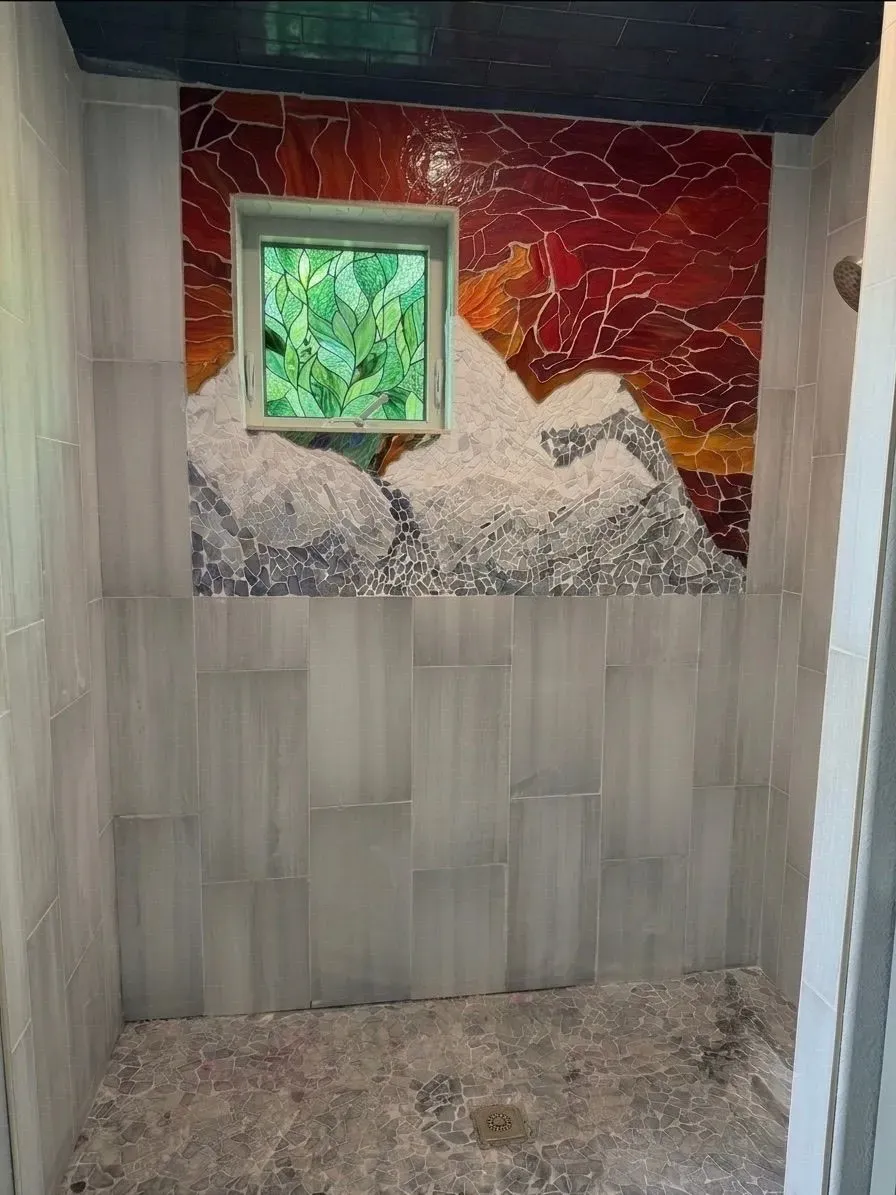
A mosaic tile shower wall can turn a routine bathroom into a private landscape.
A mountain scene can sit behind the water. A restrained geometric pattern can give a quiet bathroom its center. A small medallion can add personality without competing with the rest of the room.
The key is integration. The mosaic should work with the shower’s niches, fixtures, glass, floor slope, lighting, and surrounding field tile. It should look composed, not dropped into place as an afterthought.
The kitchen backsplash
A mosaic backsplash has a practical role. It protects the wall behind the range, sink, or prep area.
It can also become the kitchen’s center of gravity.
The Fishtail Mountain kitchen mosaic in Manitou Springs brings a Colorado landscape into the room without turning the kitchen into a theme set. The surrounding materials remain useful and restrained. The hand-cut art gives the space its identity.
A backsplash does not have to shout. It only needs to say something specific.
Fireplace surrounds and feature walls
A fireplace surround is already an architectural focal point. Mosaic can give it a deeper sense of place.
A Garden of the Gods-inspired landscape could translate red rock formations, distant peaks, sky, and vegetation into cut glass. It is the kind of Colorado subject that works beautifully as surface: recognizable, tactile, and built to be seen from across the room.
Feature walls in entries, living rooms, and dining spaces can work the same way. The art becomes part of the room’s structure instead of another object competing for attention.
Entryways, mudrooms, and stair risers
These spaces are often treated as purely practical. That is precisely why they are good locations for a considered detail.
A small mosaic in an entryway can establish the mood of the home before anyone reaches the living room. A durable design in a mudroom can bring color to a space built for boots, coats, and ordinary mess. Stair risers can carry a repeated pattern or a gradual sequence of color.
Daily traffic is not a reason to avoid beauty. It is a reason to place it where you will actually see it.
Bar areas and outdoor spaces
A bar backsplash, serving area, or wine room can support a richer, more intimate composition. Dark glass, stone, and metallic accents can create depth without requiring a large installation.
Outdoor and patio mosaics require more planning. Materials must suit exposure, moisture, temperature changes, and the specific conditions of the site. Colorado’s freeze-thaw cycles are not particularly sentimental. The build must account for them.
The correct material and the correct foundation come before the decorative idea.
A short list from the workshop
The Glass Lion’s portfolio includes a carefully chosen range of custom work:
- Alpine Sunset: a hand-crafted mountain sunset built into a shower, turning an everyday ritual into a private view.
- Pikes Peak Shower Mosaic: a Colorado landmark translated into glass for a shower wall.
- Northern Lights Shower Mosaic: vivid sky color cut into a space designed for real life.
- Mallard Duck Medallion: a detailed focal piece placed inside a clean, restrained shower design.
- Fishtail Mountain: a custom kitchen mosaic made for a home in Manitou Springs.
Colorado landscape subjects can also be developed into custom hand-cut mosaics, including red rock, mountain, and sky compositions inspired by places like Garden of the Gods.
See the full body of work, including custom showers, backsplashes, and mosaic features.
The details that make the difference
Hand-cut versus mass-produced
Mass-produced mosaic sheets are useful for many installations. They provide repeatable patterns and efficient coverage.
Hand-cut mosaic art is a different category of work. The maker selects, shapes, and places pieces to create an image or composition with variation and intention. Small decisions accumulate. A contour changes. A color shifts. A mountain ridge becomes more convincing because the pieces follow its movement.
That is the difference between a pattern and a piece of art.
Glass versus stone mosaic
Glass offers reflection, saturation, and movement as the light changes. It is especially effective for skies, water, fire, foliage, and bright color transitions.
Stone offers weight, softness, and natural variation. It can make a mountain scene feel grounded or give a neutral composition a quieter presence.
The choice depends on the subject, the location, the light, and the surrounding materials. Sometimes the strongest work combines both.
Grout is part of the composition
Matching grout can make a mosaic feel quieter and more continuous. It allows the pieces to read as one image.
Contrasting grout emphasizes each individual fragment and can make the pattern more graphic.
Neither approach is automatically correct. The choice depends on whether the design needs cohesion, definition, or a balance of both. Grout is not filler between the important parts. It is one of the important parts.
Mesh-mounted sheets and visible grid lines
Mesh-mounted sheets can make detailed mosaic installation more manageable. They hold small pieces together and help preserve spacing during installation.
They do not guarantee an invisible installation.
If sheets are poorly aligned, seams can create visible grid lines or breaks through the artwork. Careful layout, sheet transitions, field cuts, and grout placement matter. A skilled installer treats the artwork as one composition, not as a stack of unrelated sections.
There is no magic mesh. There is only good planning.
Frequently asked questions
Is mosaic tile art expensive?
Custom mosaic art requires design time, hand-cutting, material selection, detailed placement, and skilled installation. It is more involved than installing a standard tile pattern.
The right question is not only what the mosaic costs. It is what role it will play in the room, how long it should last, and whether it is being built as a replaceable finish or a lasting architectural feature.
The Glass Lion does not publish a one-size-fits-all catalog price because each project is designed around its subject, scale, materials, and setting.
How long does a custom piece take?
The time depends on the size, complexity, materials, design development, and installation conditions. A small medallion and a full shower-wall landscape are very different projects.
A consultation is the best way to discuss the scope realistically. No invented deadline. No rushed placement. Good work takes the time its details require.
Can mosaic art go in a shower or other wet area?
Yes. Mosaic art can be installed in showers and other wet areas when the entire system is designed and built correctly.
The waterproofing is behind the tile. At The Glass Lion, premium Schluter waterproofing systems provide the foundation for custom shower installation. Materials, grout, sealant, slope, drainage, and installation methods must all suit the environment.
The artwork should be treated as part of a shower system, not as a picture glued to a wet wall.
Should I choose glass or stone mosaic?
Choose glass for reflective light, vivid color, and a more luminous finish. Choose stone for natural variation, weight, and a quieter tactile surface.
Many custom pieces benefit from both. The material should serve the subject and the room.
Should grout match the mosaic or contrast with it?
Matching grout usually softens the joints and helps the design read as a continuous image. Contrasting grout makes each piece more visible and gives the composition a stronger graphic quality.
The choice should be made during the design process, not left as a last-minute decision.
Will mesh-mounted sheets show visible grid lines?
They can if the sheets are not aligned carefully or if transitions are handled without enough attention.
Proper installation minimizes the appearance of sheet seams. Detailed mosaics may also require hand adjustments, individual cuts, and thoughtful grout placement to keep the image continuous.
The goal is not merely to cover the wall. It is to preserve the composition across the wall.
Build something that belongs to your home
The best mosaic art does not feel like an object imported into a room. It feels as though the room was waiting for it.
A mountain shower can bring Colorado into the first hour of your day. A backsplash can turn cooking into a more considered ritual. A feature wall can hold a place, memory, or landscape in a form that will not fade when the trend changes.
That is the case for mosaic tile art.
It is personal expression with a structural foundation. It is handwork with professional control. It is art made to be used, cleaned, touched, and lived with.
If you are planning a custom mosaic tile art piece, a mosaic backsplash, a mosaic tile shower wall, or another form of custom tile design around Colorado Springs or the Front Range, start a conversation with The Glass Lion.
Bring the idea. Simon will help give it a lasting form.